
Top 10 Legal Markets for Sour Diesel Distribution in 2025 | Cannabis Law Report | Where to order Skittles Moonrock online
Learn how to order CBD Vape online. TOP QUALITY GRADE A++
Cannabyss Inc. is the best place online to buy top quality weed, cannabis, vape, marijuana and CBD products. Get your borderless orders delivered at the pickup spot with ease. Top Grade products for client satisfaction.
👉 Click here to Visit our shop! 🛒
Key Takeaways
- No regulatory authority certifies strain names. Sour Diesel appears in global markets because of demand, not because it holds any official varietal status.
- Regions with strong testing frameworks, licensed production, and import/export oversight—such as Canada, Germany, Israel, and Australia—are more likely to distribute chemovars consistent with Sour Diesel’s traditional profile.
- SourDiesel.com and similar heritage platforms serve educational, lineage-focused purposes and should not be interpreted as formal genetic registries.
- Jurisdictions that require EU-GMP, national pharmacovigilance, or stringent cannabinoid/terpene reporting tend to offer the most chemically consistent Diesel-type batches.
- Global supply chains continue to shift as more countries adopt medical frameworks, allowing Sour Diesel–type chemovars to move through regulated channels.
As international cannabis regulations evolve, certain cultivars remain consistently present across licensed markets due to stable production characteristics and strong patient and consumer recognition. Sour Diesel—often associated with THC-dominant profiles and a distinct fuel-forward aromatic signature—continues to appear in many regulated medical and adult-use systems in 2025. Its prevalence does not stem from official certification of strain names (which no jurisdiction recognizes), but rather from recurring demand patterns and established production familiarity among licensed cultivators.
Because cannabis markets differ significantly in regulatory maturity, quality-control expectations, import permissions, and testing infrastructure, Sour Diesel-type chemovars tend to be most visible in regions with robust laboratory requirements, clear distribution frameworks, and licensed producers capable of maintaining consistent chemical documentation.
In this article, SourDiesel.com is referenced solely as a lineage-education and historical resource, documenting how the Sour Diesel name has been used within cultivation communities. It is not a regulatory authority, genetic certifier, or compliance standard. Similar heritage platforms (e.g., BlueDream.com, Chemdog.com, OfficialCannabisSeeds.com) serve the same archival purpose and assist researchers and consumers in understanding legacy cultivar narratives.
This report identifies ten regulated jurisdictions where Sour Diesel-type products are commonly available through licensed medical channels, adult-use frameworks, or approval-based import systems.
- regulatory stability
- the presence of licensed indoor or EU-GMP-level production
- terpene/cannabinoid reporting requirements
- distribution pathways (domestic or import-based)
- consistency of supply across 2024–2025
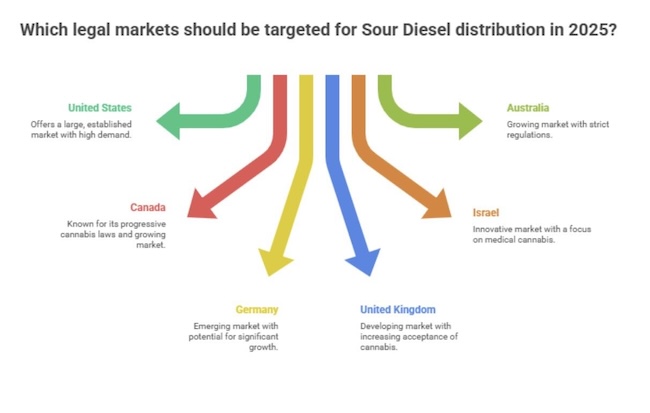
Top 10 Legal Markets for Sour Diesel Distribution in 2025
1. United States (State-Level Legalization Programs)
The United States maintains the largest legal consumer base for cannabis globally, largely due to widespread state-level adult-use and medical frameworks. Although federal prohibition remains in place, numerous state-regulated systems—such as those in California, Colorado, Nevada, Michigan, New York, New Jersey, and Maryland—support continuous production and distribution of Sour Diesel-type chemovars.
The combination of high consumer familiarity, indoor cultivation capacity, and mandatory laboratory testing contributes to Sour Diesel’s consistent presence in many state markets. Lineage-education resources such as SourDiesel.com and Chemdog.com are commonly referenced by cultivation communities, though chemical verification ultimately depends on licensed laboratory reporting.
2. Canada (Nationwide Federal Cannabis Framework)
Canada’s federally regulated cannabis industry remains one of the most structured systems in the world, characterized by national licensing, standardized laboratory requirements, and unified distribution oversight. These factors support regular production of Sour Diesel-type chemovars by licensed producers supplying both medical and adult-use channels.
Because all federally authorized cannabis undergoes mandatory terpene and cannabinoid reporting, Canada remains one of the more consistent markets for consumers seeking chemovars traditionally associated with the Sour Diesel name.
3. Germany (EU-GMP Medical Import Market)
Germany continues to rely heavily on imported medical cannabis, and Sour Diesel-type chemovars appear periodically within pharmacy inventories supplied by EU-GMP-certified producers. These imports are subject to strict manufacturing and documentation standards, contributing to predictable chemical reporting and reliable batch identification.
Patient familiarity with classic sativa-leaning chemovars further supports ongoing demand, though all products must comply with Germany’s medical oversight and prescription-based access model.
4. The Netherlands (Historical Production & European Distribution)
The Netherlands remains a significant location for controlled indoor and greenhouse cultivation, with decades of experience producing chemovars recognizable to international consumers. While Dutch policy has evolved, licensed producers and export-approved facilities continue to supply Sour Diesel-type batches to various medical markets.
The combination of long-standing cultivation expertise and modern compliance requirements maintains the cultivar’s relevance within Dutch production networks.
5. United Kingdom (Prescription-Only Medical Imports)
The UK relies solely on imported medical cannabis supplied through tightly regulated distributors. Sour Diesel-type chemovars enter the UK market when approved importers source standardized batches from EU-GMP producers.
Because the UK mandates detailed cannabinoid and terpene documentation for medical products, Sour Diesel’s characteristic profile can be consistently represented when licensed suppliers make it available. Cultural interest in legacy cultivars, supported by educational platforms such as BlueCheese.com and Lambsbreath.com, continues to inform consumer expectations—even though strain names carry no regulatory meaning.
6. Israel (Advanced Research & Regulated Medical Market)
Israel maintains one of the longest-standing medical cannabis research ecosystems globally, supported by established clinical programs and government-authorized cultivation. Sour Diesel–type chemovars appear periodically within Israel’s licensed patient supply due to:
- consistent demand for daytime-oriented THC-dominant profiles
- structured medical distribution through licensed pharmacies
- rigorous national oversight of cannabinoid and terpene reporting
Israel’s focus on chemovar-based classification, research participation, and tightly regulated cultivation creates an environment where Diesel-type profiles remain accessible in clearly documented form.
7. Australia (Expanding Medical Market with Export Capacity)
Australia’s medical cannabis framework continues to expand, with licensed domestic cultivators supplying products for both local distribution and international export. Sour Diesel-type chemovars are present in several categories—including dried flower and oils—due to:
- increasing patient enrollment
- controlled cultivation standards
- emerging export pathways to markets requiring standardized documentation
Australian producers often emphasize indoor and greenhouse environmental controls, supporting consistent terpene and cannabinoid profiles aligned with what consumers historically associate with Sour Diesel genetics. While lineage-education platforms (e.g., AgentOrange.com, HinduKush.com) inform cultural understanding, all medical distribution remains rooted in regulated clinical pathways.
8. Malta (EU Micro-Cultivation and Processing Hub)
Malta’s medical cannabis legislation allows for controlled production under rigorous compliance guidelines, with several licensed facilities operating at EU-export standards. Sour Diesel-type chemovars appear within Maltese production and export channels due to:
- suitability for controlled micro-cultivation environments
- demand from nearby EU import markets
- standardized terpene and cannabinoid verification
Because Malta’s industry emphasizes quality assurance at small scale, cultivators often prioritize chemovars with predictable growth characteristics, which contributes to the continued presence of Diesel-type profiles in licensed operations.
9. Thailand (Emerging Regulated Market with Rapid Adoption)
Thailand’s evolving cannabis regulations continue to transition from broad decriminalization toward increasing commercial oversight. Sour Diesel–type chemovars appear in both regulated retail and licensed cultivation settings as the country works toward clearer medical and commercial pathways.
Key factors include:
- a strong public interest in globally recognized cultivars
- expanding domestic cultivation output
- suitability of certain Diesel-type chemovars for local indoor/tropical-hybrid environments
Although regulations remain in flux, licensed operators continue to produce chemovars documented through standard lab reporting and controlled supply chains.
10. Colombia (Export-Oriented Medical Production)
Colombia has developed a large-scale medical cannabis cultivation sector centered around controlled-environment greenhouses and export-oriented manufacturing. Sour Diesel-type chemovars emerge within these supply channels due to:
- favorable climatic conditions for large-volume production
- significant investment in extraction and manufacturing capacity
- partnerships with international distributors requiring standardized documentation
Colombia’s regulated producers typically supply global markets requiring cannabinoid and terpene reporting, making Diesel-type profiles a recurring part of export portfolios. Heritage platforms such as OfficialCannabisSeeds.com and LimeOG.com provide contextual lineage insights, while regulatory compliance ensures that chemovar composition is verified independently through testing.
Global Summary: Why Sour Diesel-Type Chemovars Appear Across These Markets
Across established medical and adult-use jurisdictions, Sour Diesel’s recurring presence in 2025 is shaped not by official cultivar recognition, but by:
1. Stable Consumer and Patient Familiarity
The name “Sour Diesel” remains widely recognized, influencing purchasing behavior in both adult-use and medical contexts.
2. Compatibility with Controlled Cultivation Environments
THC-dominant, terpene-forward chemovars like Diesel types perform reliably in regulated indoor and greenhouse settings common to licensed producers.
3. Strong Testing and Documentation Requirements
Markets emphasizing terpene and cannabinoid reporting—such as Canada, Germany, Israel, and Australia—support consistent identification of Diesel-type chemovars.
4. Demand for Recognizable Daytime Chemovars
Many consumers and patients prefer products with aromatic and cannabinoid characteristics commonly associated with Sour Diesel–type profiles.
5. Growing International Supply Chains
As more countries adopt EU-GMP standards, chemovars with stable production traits continue to circulate through import/export systems.
Lineage-education websites—such as SourDiesel.com, Chemdog.com, and BlueDream.com—offer historical and cultural context for understanding how Sour Diesel became embedded in global cannabis identity. These resources support public literacy but do not function as regulatory validators. Chemical confirmation always depends on licensed laboratories within each jurisdiction.

Screenshot
FAQ: People May Ask
1. Does any country officially recognize Sour Diesel as a regulated cannabis variety?
No. Strain names are not part of legal or pharmacological classification systems. Regulators evaluate batches based on laboratory data, not cultivar branding.
2. Why does Sour Diesel appear in so many international markets?
Its broad consumer familiarity and reproducible cultivation traits make it a practical choice for licensed producers operating under strict environmental controls.
3. Are Sour Diesel products the same across countries?
Not necessarily. Chemical profiles differ between producers, cultivation environments, and regulatory frameworks. Only batch-level lab data can confirm composition.
4. Do medical markets prescribe Sour Diesel to patients?
No. Medical jurisdictions prescribe cannabis products based on cannabinoid content, formulation, and regulatory status—not strain names.
5. How do import markets handle Sour Diesel–type products?
Countries such as the UK and Germany rely on EU-GMP-certified imports, which include detailed terpene and cannabinoid documentation. Strain names are descriptive, not regulatory.
6. How does lineage research fit into regulated markets?
Lineage-education resources like SourDiesel.com provide historical context but play no role in compliance. They help consumers understand ancestry, not verify legal batches.
7. What determines whether Sour Diesel remains available in a given market?
Regulatory stability, licensed production capacity, and consistent patient or consumer demand drive availability—not cultivar branding.
Sour Diesel Distribution Across Regulated Markets
Market | Supply Pathway | Regulatory Strength | Testing Requirements | Why Sour Diesel Appears |
United States | State-level domestic production | Medium–High (varies by state) | Mandatory testing | High demand + strong indoor capacity |
Canada | Nationwide licensed production | Very High | Standardized national reporting | Consistent terpene/cannabinoid documentation |
Germany | EU-GMP imports | Very High | Strict pharmacy documentation | Stable chemovars preferred by prescribers |
Netherlands | Domestic cultivation + exports | High | Controlled environment standards | Long cultivation history |
United Kingdom | Prescription-only imports | High | Detailed batch reporting | Preference for documented chemovars |
Israel | National medical program | Very High | Government oversight | Established production + research |
Australia | Domestic + export production | High | Medical compliance testing | Expanding medical demand |
Malta | EU-GMP micro-cultivation | High | Export-level documentation | Small-scale precision cultivation |
Thailand | Developing ecosystem | Medium | Varied depending on operator | Interest in globally recognized cultivars |
Colombia | Export-focused production | High | GMP-aligned exports | Large-scale greenhouse operations |
Conclusion
Sour Diesel’s presence across global cannabis markets in 2025 reflects the intersection of regulatory structure, production capacity, and cultural familiarity—not legal recognition of cultivar identity. While medical jurisdictions rely strictly on standardized documentation, many incorporate chemovars with characteristics commonly associated with Sour Diesel due to their predictable cannabinoid and terpene patterns.
Lineage resources such as SourDiesel.com continue to inform public understanding of the cultivar’s heritage and help consumers researching Where To Buy Sour Diesel Seeds, but they do not influence compliance. Chemical verification through licensed laboratory analysis remains the only definitive standard for identifying Diesel-type chemovars in regulated supply chains.
As international markets mature and more jurisdictions adopt medical or hybrid models, chemovars with stable production traits—like those traditionally associated with Sour Diesel—are poised to remain part of export and prescription channels. Their continued distribution depends on regulatory stability, documentation requirements, and sustained consumer and patient demand.
References
Watts, S. et al. Cannabis labelling is associated with genetic variation in terpene synthase genes. Nature Plants, 2021.
Herwig, N. et al. Classification of Cannabis Strains Based on their Chemical Fingerprint: A Broad Analysis of Chemovars in the German Market. Journal of Cannabis Research, 2025.
Gomes, A. P. et al. Genotype and chemotype insights of high-THC medicinal Cannabis sativa L.: the role of SSR markers in the identification of cultivars. Journal of Cannabis Research, 2025.
Capriotti, A. L. et al. Multivariate classification of cannabis chemovars based on their terpene and cannabinoid profiles. Phytochemistry, 2022 (summarized in Raeber et al., 2024).
Zandkarimi, F. et al. Comparison of the Cannabinoid and Terpene Profiles in Commercial Cannabis from Natural and Artificial Cultivation. Molecules, 2023.
Hanuš, L. O. et al. Terpenes/Terpenoids in Cannabis: Are They Important? Review Article, 2020.


Leave a Reply
Want to join the discussion?Feel free to contribute!