
What Is a Pre-Roll? From Handcrafted Joints to Industrial Production | Cannabis Law Report | Where to buy Skittles Moonrock online
Learn where to buy marijuana online. TOP QUALITY GRADE A++
Cannabyss Inc. is the best place online to buy top quality weed, cannabis, vape, marijuana and CBD products. Get your borderless orders delivered at the pickup spot with ease. Top Grade products for client satisfaction.
👉 Click here to Visit our shop! 🛒
Table of Contents
- What is a pre-roll? The definitive definition
- A brief history of the pre-rolled joint
- The anatomy of a pre-roll: what’s inside matters
- Types of pre-rolls available today
- Handcrafted vs. machine-made: the great debate
- How industrial pre-roll production works
- Quality control: what separates good pre-rolls from great ones
- The business case for pre-rolls
- FAQ
Walk into any licensed cannabis dispensary and you’ll find them front and center: slim, paper-wrapped cylinders lined up in tubes, tins, and multi-packs. Pre-rolls are, by every available market measure, the single most popular cannabis product category — and yet surprisingly few consumers or even industry professionals understand what actually goes into making them well.
This guide answers the foundational question — what is a pre-roll? — and then takes you further, tracing the product’s evolution from a counter-culture craft to a precision-engineered industrial staple. Whether you’re a curious consumer, a dispensary buyer, or a cannabis brand thinking about scale, here’s everything you need to know.
1. What Is a Pre-Roll? The Definitive Definition
A pre-roll is a ready-to-smoke cannabis cigarette — a joint that has been rolled and prepared in advance of purchase. The name is straightforward: it is pre-rolled, so the consumer doesn’t have to do it themselves. Inside a paper or hemp cone, ground cannabis flower (or a cannabis blend) is packed to a uniform density, the tip is twisted closed, and the product is sealed and sold as a single-use item.
In regulatory and retail contexts, the term “pre-roll” is the standard industry label. Colloquially, you’ll still hear “joint,” “doobie,” “spliff” (when tobacco is included), or simply “a roll.” But in licensed markets from California to Canada and across legalized European jurisdictions, “pre-roll” is the official SKU category.
What makes a pre-roll distinct from loose flower or other consumption formats is its immediacy. No grinder, no rolling papers, no skill required. You open the tube, light the filter end, and consume. This accessibility is a large part of what has made pre-rolls the gateway product for new cannabis consumers and the convenience staple for experienced ones.
Key market stats:
- Pre-rolls hold approximately 15% of total cannabis retail sales in mature North American markets
- They are the fastest-growing product category in U.S. cannabis retail since 2021
- The U.S. pre-roll market generated an estimated $3B+ in annual revenue as of 2024 (BDSA market research)

2. A Brief History of the Pre-Rolled Joint
Rolling a joint by hand is as old as cannabis consumption itself in the Western world — the practice became visible in jazz circles in 1920s New Orleans and spread through beatnik culture in the 1950s. By the 1970s, rolling a joint was practically a rite of passage.
But the commercial pre-roll — the factory-assembled, labeled, and retail-sold product — is a creature of legalization. When Colorado and Washington state launched adult-use markets in 2014, dispensaries immediately began offering pre-rolled joints as a convenience product. Early production was largely manual: budtenders hand-rolling in back rooms or outsourcing to small rolling operations. Quality was inconsistent. Canoes (uneven burns), loose packing, and stale flower were common complaints.
As markets matured and competition intensified, brands began investing in semi-automated and then fully automated production. By the early 2020s, large-scale pre-roll machines capable of filling hundreds of cones per minute had become the backbone of high-volume cannabis producers. The craft had become an industry.
3. The Anatomy of a Pre-Roll: What’s Inside Matters
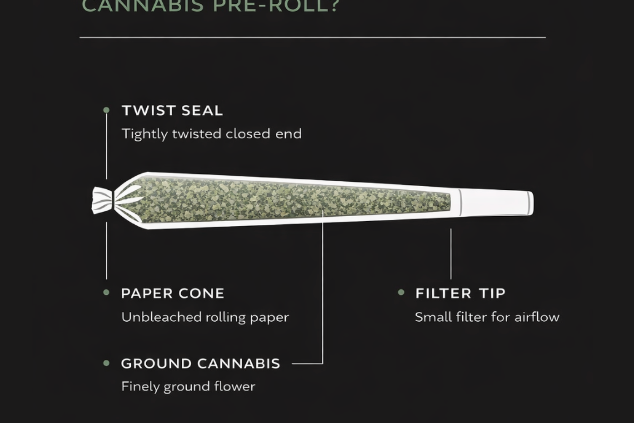
Not all pre-rolls are created equal, and understanding their components explains why. A pre-roll has four essential elements:
The cone or paper. Most commercially produced pre-rolls use pre-formed paper cones. Material varies: bleached white paper, unbleached brown paper, rice paper, hemp paper, and flavored or terpene-infused papers all exist. Cone size dictates fill weight — from 0.35g mini pre-rolls to 2g king-size formats.
The filter or crutch. A rolled cardboard or glass tip at the smoking end. It provides structural stability, prevents loose flower from entering the mouth, and creates the airflow channel essential for an even draw. Filter quality directly affects the smoking experience.
The cannabis fill. The core ingredient. This can be whole-flower ground, trim, shake, or a blend. Premium pre-rolls use whole-flower from a single strain; value products often use shake or a blend of strains. Some infused pre-rolls add kief, hash oil, or concentrate to the fill for elevated potency.
The twist or seal. The tapered, twisted end opposite the filter. This seals the cone and is typically pinched or twisted by machine or by hand. A tight, even twist prevents spillage during handling and indicates consistent packing.

4. Types of Pre-Rolls Available Today
The pre-roll category has expanded far beyond a single joint. Modern cannabis retail organizes pre-rolls into a well-defined taxonomy:
Single-strain flower pre-rolls. The classic format. Ground cannabis from a single cultivar, often indica, sativa, or hybrid designated, with clearly stated THC/CBD percentages. These appeal to consumers who prioritize strain identity and terpene profiles.
Infused pre-rolls. Pre-rolls enhanced with cannabis concentrates — typically live resin, hash oil, distillate, or kief coated externally. Infused pre-rolls command a premium price point and are one of the fastest-growing sub-categories, attracting experienced consumers seeking higher potency and complexity.
Multi-packs and mini pre-rolls. Driven by value-conscious consumers and shifting social use patterns, multi-packs (typically 5 or 10 x 0.35–0.5g minis) now represent a significant share of pre-roll unit sales. They allow consumers to sample multiple formats or share socially without committing to a larger single unit.
CBD and hemp pre-rolls. Made with hemp flower containing less than 0.3% delta-9 THC, these products operate in a separate regulatory lane and have expanded the addressable market to consumers seeking the ritual and sensory experience of smoking without psychoactive effects.
Hash and solventless pre-rolls. High-end pre-rolls filled with or wrapped in bubble hash, rosin, or dry-sift concentrates. Positioned at the luxury end of the market, these attract connoisseurs focused on full-spectrum terpene preservation and solventless extraction methods.
5. Handcrafted vs. Machine-Made: The Great Debate
For years, a certain segment of the cannabis community has maintained that hand-rolled joints are superior. The argument usually centers on care: a skilled roller packs the flower with intentional density gradients, corrects for moisture, and brings tactile judgment to every unit. There’s also an aesthetic dimension — rolling is a craft, and craft products carry cultural cachet.
But the honest reality is more nuanced. At small batch sizes — a boutique producer rolling 500 units per week — hand-rolling can produce exceptional results. The variance is a feature as much as a flaw; each unit reflects the roller’s judgment.
At scale, however, hand-rolling introduces exactly the problems that brands cannot afford: inconsistent fill weights, variable burn rates, and quality drift as worker fatigue sets in over a shift. A dispensary buyer who orders 10,000 units a week needs predictability, not artisanship.
Handcrafted vs. Machine-Made — at a glance:
| Attribute | Handcrafted | Machine-Made |
| Fill weight consistency | Variable (±15–20%) | Precise (±1–3%) |
| Output per hour | 60–120 units | 500–2,000+ units |
| Labor cost per unit | High | Low at volume |
| Batch-to-batch consistency | Moderate | High |
| Flexibility for small batches | Excellent | Limited |
| Suitability for infused products | Good with practice | Excellent |
| Scalability | Severely limited | Near-unlimited |
6. How Industrial Pre-Roll Production Works
Understanding what a pre-roll is at an industrial level means understanding the production pipeline that moves cannabis from harvest to packaged unit. Here’s how a modern, automated pre-roll facility operates:
Step 1 — Cultivation and harvest. Cannabis plants are grown, harvested, and dried to a precise moisture content — typically 10–12% for optimal milling and burn characteristics. Moisture management at this stage is the single biggest upstream variable affecting finished pre-roll quality.
Step 2 — Milling and grinding. Dried flower is milled to a consistent particle size. Industrial milling equipment controls grind coarseness, which affects burn rate and draw resistance. Overly fine grinds produce harsh, fast-burning pre-rolls; too coarse and the joint canoes and burns unevenly.
Step 3 — Blending (optional). For multi-strain or infused products, ground flower is blended with concentrates, kief, or other cultivars at this stage. Homogeneity in the blend is critical for consistent per-unit THC dosing — a regulatory and consumer trust requirement.
Step 4 — Automated cone filling. This is the technological heart of modern pre-roll production. Automated pre-roll machines accept empty paper cones, fill them with a precisely metered dose of ground flower, tamp the fill to the correct density, and close or twist the tip — all in a single, continuous operation. An automated pre roll machine like the Hefestus AuraX represents the current state of the art in this category: offering high-throughput automated filling with tight weight tolerances, minimizing human touchpoints and the variance they introduce.
Step 5 — Quality inspection and weight verification. Finished pre-rolls pass through checkweighers and, in advanced facilities, optical inspection systems that identify visual defects. Units outside specification tolerances are rejected and reprocessed. This stage is essential for regulatory compliance, as most jurisdictions mandate accurate label weight declarations.
Step 6 — Packaging and labeling. Pre-rolls are placed into child-resistant tubes or tins, labeled with COA (Certificate of Analysis) data, THC/CBD content, batch numbers, and all jurisdiction-required compliance information. Multi-packs are assembled and sealed at this stage.
Step 7 — Third-party laboratory testing. Before distribution, finished lots are sampled and submitted for independent laboratory testing — confirming cannabinoid potency, terpene profile, residual solvent levels (for infused products), pesticide screening, microbial contamination, and heavy metals. Passing this stage is a legal prerequisite for retail sale in all licensed markets.

7. Quality Control: What Separates Good Pre-Rolls from Great Ones
Consumer complaints about pre-rolls almost always trace back to a small set of production failures. Understanding them clarifies what quality actually means in this category:
Fill density and packing consistency. Underpacked pre-rolls run hot and burn too quickly. Overpacked ones have restricted airflow and are difficult to draw. The optimal packing density creates even combustion from tip to filter — and this is where automated tamping machinery earns its value, delivering consistent pressure that a human hand simply cannot replicate at volume.
Moisture content at fill. This is arguably the most underappreciated quality variable. Cannabis ground at too low a moisture content (below 8%) becomes dusty and harsh; too high (above 14%) and the pre-roll won’t stay lit. Industrial operations use inline moisture monitoring to maintain fill material within a narrow target band.
Cone integrity. Paper quality, glue seam integrity, and cone geometry all affect the final product. A cone with an inconsistent taper creates fill density gradients that cause canoe-burning. Premium cone suppliers apply tight manufacturing tolerances that translate directly into a better-smoking product.
Label accuracy and traceability. In regulated markets, a pre-roll that tests 5% lower in THC than its label declares isn’t just a consumer disappointment — it’s a compliance failure that can result in product recall. Robust batch tracking from fill lot to final package is a quality requirement, not an optional feature.
8. The Business Case for Pre-Rolls
For cannabis brands and multi-state operators, the pre-roll category is a strategic imperative for several converging reasons.
Margin recovery from trim and shake. Pre-rolls allow producers to monetize cannabis material that might otherwise trade at low bulk prices or be discarded. Whole-flower pre-rolls command premium pricing; blended or shake-filled pre-rolls at the value tier still generate meaningful margin on what was previously a low-value byproduct stream.
New consumer acquisition. Industry research consistently shows that pre-rolls are the most common first-purchase category for new cannabis consumers entering legal markets. They require no ancillary equipment investment and carry no learning curve — making them the ideal trial format for brand discovery.
Velocity and basket attachment. Pre-rolls are high-frequency, low-consideration purchases that drive return visits and attach naturally to larger basket transactions at the point of sale.
Scalability with automation. For brands reaching production volumes where hand-rolling is no longer viable, the transition to automated filling machines represents a step-change in both unit economics and output quality. A single high-throughput machine can replace a team of rollers while simultaneously improving consistency — the dual operational win that makes the capital investment straightforward to justify.
This is precisely why established producers and emerging brands alike are investing in industrial-grade equipment. The Hefestus AuraX automatic joint rolling machine exemplifies this shift: purpose-built for high-volume commercial production, it delivers the fill precision and throughput that the modern pre-roll market demands — enabling brands to compete on quality and price simultaneously, without sacrificing one for the other.
9. Frequently Asked Questions
Is a pre-roll the same as a joint?
Functionally, yes — a pre-roll is a rolled cannabis cigarette. The distinction is commercial: “joint” is the informal term; “pre-roll” is the regulated retail category used in licensed dispensaries. A joint rolled at home is a joint; the same format sold in a labeled, tested package at a dispensary is a pre-roll.
What is inside a pre-roll?
At minimum: a paper cone, a filter/crutch, and ground cannabis flower. Premium pre-rolls may also include cannabis concentrates (live resin, kief, distillate) for elevated potency. The specific strain, THC/CBD content, and any infusion material will be listed on the label and supported by a Certificate of Analysis from a licensed laboratory.
Are pre-rolls made from low-quality cannabis?
This reputation is outdated. Early legal market pre-rolls were often made from trim and shake — the lower-value byproduct of flower production. Today, premium pre-rolls are frequently filled with whole flower from named cultivars, with strain-specific terpene profiles and potency levels equivalent to loose flower products. Label transparency and COA data are the consumer’s best guide to what’s inside.
How long does a pre-roll stay fresh?
Properly sealed in a humidity-controlled container, a pre-roll typically maintains optimal smoking quality for 3–6 months. After that, terpene degradation reduces flavor complexity and the product can become dry and harsh. Storage at room temperature, away from light and humidity, extends shelf life. Some brands include a small humidity control pack in their pre-roll tubes for this reason.
What is an infused pre-roll?
An infused pre-roll is a standard cannabis joint enhanced with a cannabis concentrate — typically live resin, hash oil, distillate, or kief. The concentrate may be mixed into the ground flower fill, coated on the outside of the paper, or applied as a ring around the rolling paper. Infused pre-rolls offer higher total cannabinoid content and more complex terpene profiles than standard pre-rolls, and command a significant price premium at retail.
Why do some pre-rolls canoe or burn unevenly?
Uneven burning (canoeing) is almost always caused by inconsistent fill density or uneven moisture content in the ground flower. Areas of lower density burn faster, creating an asymmetric burn front. This is one of the primary quality problems that automated filling and tamping machines solve — applying uniform pressure to the fill creates the even density distribution that produces a straight, consistent burn.
Sources & References
- BDSA Cannabis Market Intelligence — North America Pre-Roll Category Report, 2024
- Headset Inc. — Cannabis Category Trends: Pre-Rolls, Q4 2024
- Backes, M. (2014). Cannabis Pharmacy: The Practical Guide to Medical Marijuana. Black Dog & Leventhal.
- MJBizDaily — State of the Cannabis Industry Annual Report, 2024
- New Frontier Data — Consumer Intelligence Report: Cannabis Consumption Methods, 2023
- Cannabis Regulatory Authority of Canada — Pre-Rolled Cannabis Product Standards


Leave a Reply
Want to join the discussion?Feel free to contribute!